An Insilico Medicine platform
A single injection transiently programs T cells to eliminate pathogenic cell populations.
An Insilico Medicine platform
A single injection transiently programs T cells to eliminate pathogenic cell populations.
The concept
The chassis
In-Vivo CAR-T
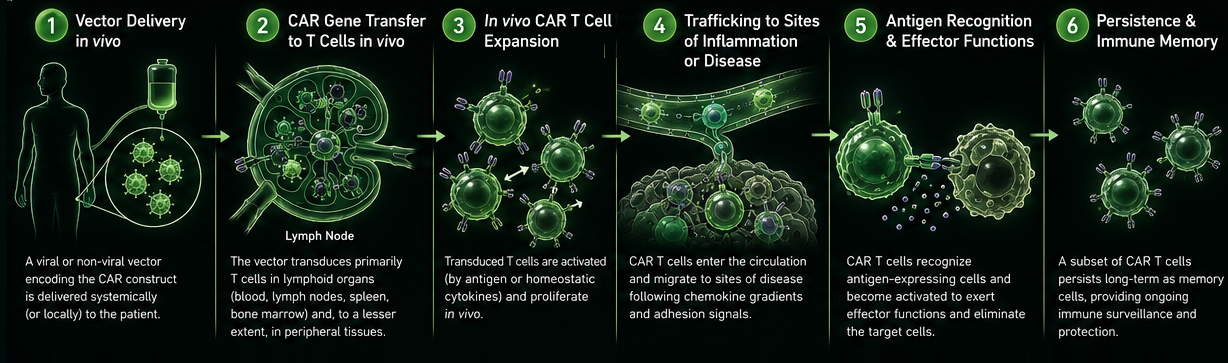
Conventional Chimeric Antigen Receptor T-cell (CAR-T) therapy is a laborious manufacturing process that engineers and expands patient T-cells ex-vivo. An emerging technology termed as in-vivo CAR-T aims to reprogram T-cells in-vivo via lipid nanoparticle-mediated targeted delivery. As such, it offers an attractive alternative to bypass the otherwise complex manufacturing process. Ultimately, it would shorten treatment timeline and reduce the cost and enable scalable off-the-shelf CAR-T therapy.
Mechanistic cascade
Generally, the immune response must be potent and durable to eliminate the target, yet temporary enough to limit prolonged immune activity. Each step of in-vivo CAR-T (selective delivery, release, efficient CAR expression, T-cell activation, and target engagement) plays a key role in CAR-T therapy efficacy and hence, may offer opportunities for further optimization.
CAR-T applications
As the CAR-T could be tailored to recognize a wide variety of antigens, the technology can be adopted/applied to a diverse range of pathologies, from cancer to autoimmune disease.
The engine
The platform
Our research
The announcement
Platform content is illustrative and does not represent clinical claims.